We use optional analytics to improve this site and marketing technology to identify business visitors for relevant outreach. You can allow all, decline optional use, or choose categories. Privacy policy

    Skip to main content

    Research · Evergreen market map

    AI rollups and AI-native private equity: the 2026 market map

    A new category of firm is buying, or economically aligning with, established businesses and transforming them with embedded AI teams. We reviewed 80+ owner-operators, acquisition platforms, and transformation firms, then graded each on public evidence. The few with verified results are listed here, alongside the honest reservations. Demos, projected margins, and branded "AI OS" claims did not count. If you own one of the businesses this category is buying, this page is also a map of your options: start here.

    By Christian Ulstrup · Published August 19, 2026 · Updated September 2, 2026 · Methodology

    At a glance

    36 firms, graded on what they can prove

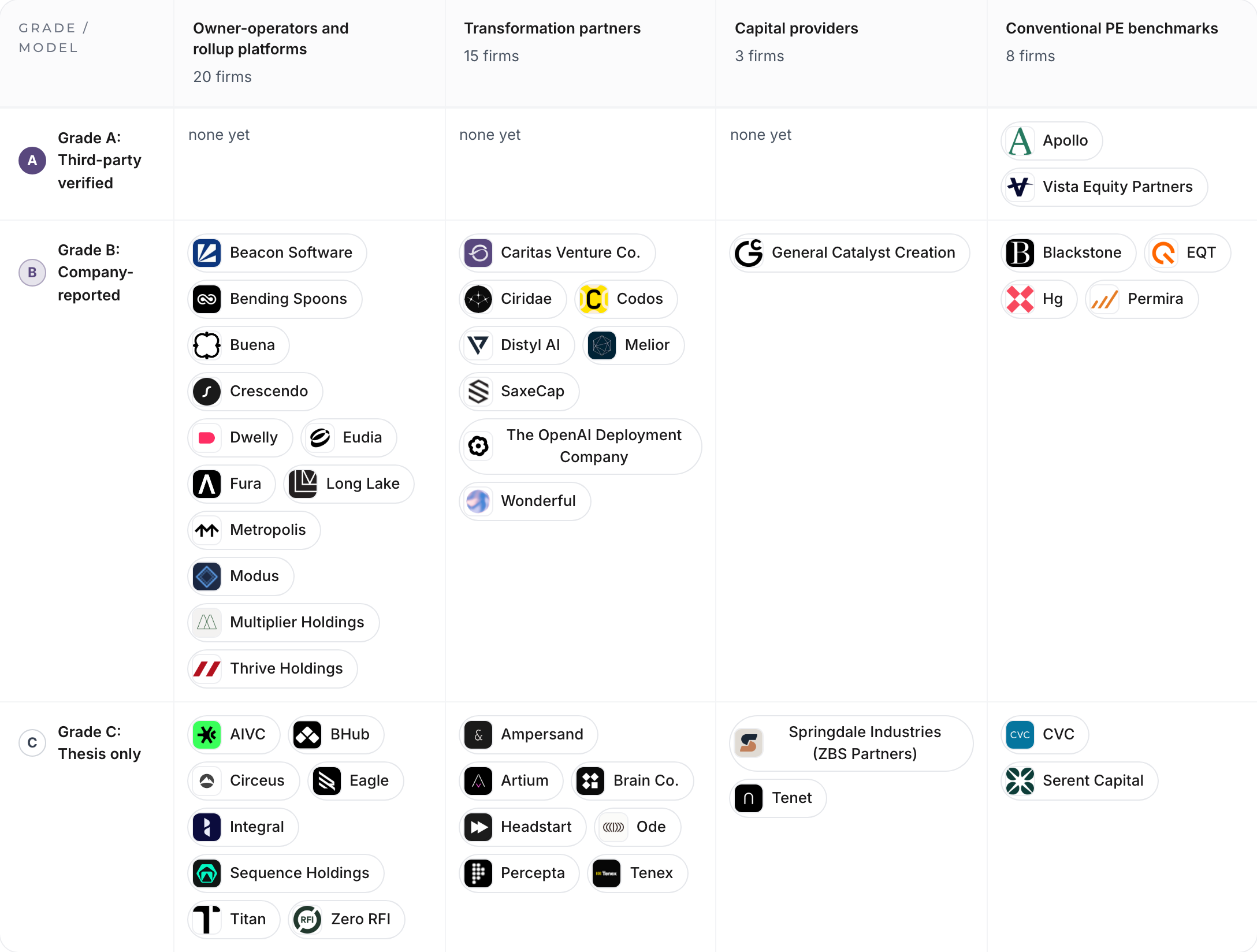
    Down the side: how strong the public evidence is. Across the top: what kind of firm it is. Click any firm to jump to its full profile, sources, and the reservation we attached to it.

    Grade / model

    Owner-operators and rollup platforms

    18 firms

    Transformation partners

    8 firms

    Capital providers

    2 firms

    Conventional PE benchmarks

    8 firms

    Grade A: Third-party verified
    none yet
    none yet
    none yet
    Grade B: Company-reported
    Grade C: Thesis only
    ANamed outcome verified by a credible third partyBCompany- or investor-reported, covered by credible pressCReal thesis, no publicly verifiable outcome yet

    The category

    What is an AI rollup? Three operating models, one thesis

    An AI rollup (also written AI roll-up, or AI-enabled roll-up in General Catalyst's coinage) buys established services businesses and deploys a reusable AI layer across them, usually holding the companies instead of flipping them. General Catalyst's Madhu Namburi calls the end state "service as software." The shared thesis: AI has collapsed the cost of transforming an established business, so whoever pairs capital with a reusable transformation capability captures the enterprise-value uplift. Three operating structures compete to do it, financed by a fourth group that funds rather than operates.

    1. Integrated owner-operators

    Acquire companies outright and transform them with in-house engineering. General Catalyst calls the acquisition-heavy version an "AI-enabled roll-up."

    2. Transformation partners

    Embed technical teams in businesses they do not own, compensated in fees, outcomes, or equity. This is the lane Caritas operates in; see the disclosure below.

    3. Conventional PE with AI programs

    Established funds running structured AI value-creation programs across existing portfolios. Still the benchmark for measurement discipline.

    Plus: the capital providers

    Investors that finance and co-create these platforms without operating them themselves. General Catalyst's Creation strategy coined the category's name; Tenet is a fund built to seed European rollups. Both appear on the map in their own column.

    For owners

    Reading this map as a business owner

    If you own an established services business, every firm on this page represents one of four paths to the same destination: a business that runs on an AI operating layer. The paths differ in what you give up to get there.

    1. Sell to a permanent-capital owner-operator

    Thrive Holdings, Long Lake, and Multiplier Holdings buy businesses outright, hold them indefinitely, and typically leave selling partners with meaningful equity. You get liquidity, and the transformation is done to the business you built. The owner-operator lane above shows what each buyer can prove so far.

    2. Join a venture-backed platform

    Crescendo, Eudia, and Dwelly run the same playbook on a fund clock: faster capital, an expected exit, and terms that usually include rollover equity. The evidence-maturing lane grades what is proven so far.

    3. Keep ownership and bring in the operating layer

    Transformation partners embed the same kind of engineering capability in a business they do not own, paid in fees or outcomes, and the margin they help create stays on your side of the table. Caritas operates in this lane; the disclosure below applies.

    4. Build it yourself, with guardrails

    The conventional-PE benchmark lane is useful even if you never take a dollar of outside capital: it shows what a disciplined AI program looks like when the owner runs it, with named leaders, measurement, and published results.

    Before you sign anything

    Five questions that separate an engine from a pitch deck, whichever path you take: audited or client-confirmed before-and-after numbers from two businesses they already own or serve; what the headline AI figure measures and who checked it; what happens to your team, brand, and client relationships in year one; what a rollover stake is actually worth, and when; and who keeps the software and the data if you part ways. The grades on this map are a head start on the first question.

    Methodology

    The evidence bar

    Every firm on this page is graded on publicly verifiable evidence of AI value creation. Named customer or portfolio results count. Demos, projected margins, and marketing claims do not. Corporate facts such as a closed acquisition or a funding round are cited but do not raise the grade on their own. Each key fact links to its own source inline; the summary and reservation text on a card draws on the same sources listed in that card's footer.

    A

    Grade A. A specific, named outcome verified by a credible third party: independent press, third-party research, SEC filings, or counterparty confirmation.

    B

    Grade B. Client-named or company-reported results published by the firm or its investors, or covered by credible press without independent attribution of the AI contribution.

    C

    Grade C. A real thesis and team, but no publicly verifiable outcome yet.

    Firms carrying the "profile reviewed by the firm" mark have confirmed or corrected their entry directly. Corrections are welcome: entries are updated as primary sources change, and every update is logged in the changelog below.

    The profiles

    Every firm, every claim, every source

    Filter by evidence grade or lane, search by name or sector, and sort. Each profile carries its key facts, the caveat we would want a fund partner to know, and links to the sources behind every number.

    Sort
    Evidence
    Lane

    Showing 36 of 36 firms

    Owner-operators · 5 firms

    Integrated owner-operators: the most substantiated

    Firms that acquire companies outright and transform them with in-house engineering, plus the capital provider that coined the category. This tier holds the category's strongest public evidence, and its biggest headline valuations.

    Beacon Software

    Owner-operator

    B

    Self-styled "anti-private equity": a permanent-hold holdco (founded 2024 by ex-Instacart president Nilam Ganenthiran and ex-Sequoia partner Divya Gupta) buying small profitable vertical-software businesses and rebuilding them on a shared AI platform.

    • 30+ companies acquired since 2024, now closing roughly one deal per weekGlobe and MailBetaKit
    • $550M+ raised, including a $225M Series C led by General Catalyst and HarbourVest at a $1.4B+ valuation (announced June 2026)Globe and MailBusinesswire
    • Reports 50%+ growth in portfolio operating earnings over the past yearGlobe and Mail

    Reservation: The EBITDA figure is a single company-reported aggregate with no named per-company breakdown, and a one-acquisition-a-week pace carries real integration risk.

    Sources: Globe and Mail · Businesswire · BetaKit

    B

    The company-creation arm that coined the term "AI-enabled roll-up": GC assembles founding teams, funds them, and helps them acquire and transform service businesses, targeting a "Rule of 60." Its co-creations include Long Lake, Eudia, Titan, Crescendo, Dwelly, and the accounting platform Accrual. GC's Madhu Namburi calls the end state "service as software."

    • Roughly a dozen rollup vehicles co-created (CNBC); the strategy's sleeve reportedly grew to ~$1.5B in Fund XIICNBCPitchBook
    • Crossed into public markets: the $7.6B Janus Henderson take-private with Trian (December 2025), which GC plans to transform through its AI transformation company Percepta, and backing Long Lake's $6.3B Amex GBT dealCNBCPitchBook
    • Investor-reported portfolio outcomes in its own essay: 25-30% productivity gains and a 10x new-customer pipeline at Long Lake's HOA business, 80%+ interaction automation at Crescendo, and doubled EBITDA margins at Dwelly where deployedGC: The Future of Services

    Reservation: Every portfolio outcome number it publishes (25-30% productivity, 10x pipeline, doubled margins) originates from GC or its portfolio companies, and GC sits on multiple sides of the trade: it co-creates the platforms, leads later rounds, and prices its own thesis.

    Sources: GC: The Future of Services · GC: Europe's AI transformation in services · CNBC · PitchBook

    Long Lake

    Owner-operator

    B

    Permanent-hold owner-operator led by ex-Oaktree Alex Taubman, acquiring services businesses in HOA management, construction, and now corporate travel, transformed on its proprietary Nexus platform. Executing the first large AI take-private.

    • $6.3B Amex GBT take-private approved by GBTG stockholders on August 3, 2026; close expected in 2H 2026 pending remaining regulatory approvalsStockholder voteAmex GBT Q2 8-K
    • $1.0B of 7.625% senior secured notes issued July 2026 to finance the deal; $600M+ equity raised in its first ~13 months (WSJ)Gibson DunnWSJ
    • 30+ businesses acquired in roughly three years (CNBC)CNBC
    • Investor-reported AI outcomes in HOA management: 25-30% productivity gains for team members (GC essay), 20-40% per CEO Alex Taubman (TBPN, May 2026), plus a 10x increase in new-customer pipeline from an AI-powered sales motionGC essayTBPN

    Reservation: The headline operating metrics (25-30% productivity gains, 10x sales pipeline) come from lead investor General Catalyst's own essay, and a 7.625% coupon puts real leverage under a permanent-hold model premised on AI margin expansion.

    Sources: Businesswire · Gibson Dunn · Stockholder vote · Amex GBT Q2 8-K · CNBC · WSJ · TBPN · GC essay

    Multiplier Holdings

    Owner-operator

    B

    Permanent holdco from ex-Stripe APAC lead Noah Pepper that acquires boutique tax and accounting firms, keeps their brands and leadership, and builds custom AI inside them, with a stated ambition to rival the Big Four.

    • Eight firms acquired (five in the past year), four more under signed term sheets; 30+ embedded technologistsBusinesswire
    • Citrine International Tax: cash flow up roughly 2.5x within eight months of acquisition (company-reported, WSJ-covered)DealroomWSJ Pro
    • $35M Series B led by The General Partnership at a $300M valuation; ex-Slack CFO Allen Shim joined as President and CFO (August 4, 2026)BusinesswireWSJ Pro

    Reservation: The flagship Citrine result is company-reported and Citrine was a 12-person firm at acquisition, so the category's cleanest proof point is also its smallest.

    Sources: WSJ Pro · Businesswire · Dealroom · TechCrunch · Multiplier (practitioner testimonial)

    Thrive Holdings

    Owner-operator

    B

    The OpenAI- and SoftBank-backed permanent-capital holdco that Thrive Capital created in April 2025 (a separate company, not a fund): it buys and holds businesses in accounting (Current, formerly Crete Professionals Alliance), IT services (Shield), and a new built-environment regulatory platform, embedding AI into their workflows.

    • Raised $2B at a $12B valuation from SoftBank, D1, and Altimeter (August 12, 2026); 70+ businesses across platformsTechCrunch
    • Current's Tax AI processed ~7,000 returns for the 2025 tax year (the spring 2026 filing season), saving practitioners about a third of their time, with drafts up to 97% accurate (OpenAI case study; Forbes reported 31% average savings)OpenAI case studyForbes
    • Shield reports help-desk resolution sped up 36x and passed $100M annual revenue in 2025TechCrunchBusinesswire (Shield)
    • Current's firm count by date: over 20 accounting firms (Reuters, June 2025), almost 30 (Current rebrand release, June 2026), more than 50 (TechCrunch, August 2026); Shield at around 20 IT services companiesReutersCurrent (Businesswire)TechCrunch
    • Hold-forever stance: 'We hold them forever' and selling partners keep meaningful equity, per its June 2026 essay Long HumansThrive Holdings: Long Humans

    Reservation: OpenAI is a shareholder, so its case study is not independent validation; press often flattens 'up to 97%' draft accuracy and '98%' data-entry accuracy into one number; and a $12B valuation on thin-margin services businesses is priced for a transformation that is still early.

    Sources: OpenAI case study · TechCrunch · Forbes · Businesswire (Shield) · Reuters · Current (Businesswire) · Thrive Holdings: Long Humans · Kirkland & Ellis (formation)

    Evidence maturing · 9 firms

    Real operators, evidence maturing

    Acquisitions are closed and operations are running, but the outcome numbers are still mostly company-reported. Watch this tier: it is where the next grade-A evidence will come from.

    Buena

    Owner-operator

    B

    Berlin AI property-management platform consolidating Germany's fragmented property managers: 25+ firms acquired and roughly 80,000 units under management.

    • $58M raised, Series A led by GV (July 2025); Forbes reported $25M ARRAxiosForbes
    • 500%+ revenue growth in 2024, company-reportedAxios

    Reservation: Growth percentages compound off a small base after a near-death restructuring, and unit counts vary across sources and dates.

    Sources: Axios · Forbes · GV interview

    Crescendo

    Owner-operator

    B

    San Francisco "augmented AI" customer-experience company: a 20-person startup that acquired 3,000-person BPO PartnerHero and charges by outcome instead of headcount.

    • $50M raised at a $500M post-money valuation, led by General Catalyst (Bloomberg)Bloomberg
    • Investor-reported: a regional telecom deployment tripled resolved calls in its first week; 80%+ of interactions fully automatableGC essay

    Reservation: Outcome metrics come from the lead investor's essay with the customer unnamed, and founding CEO Matt Price stepped back to an advisory role in July 2026.

    Sources: Bloomberg · Crescendo · GC essay · Enterprise Times

    Dwelly

    Owner-operator

    B

    London AI-native lettings group (founded by ex-Uber and Gett operators) buying independent UK letting agencies and running them on its own AI platform.

    • $170M Series B led by EQT Growth, co-led by General Catalyst (July 28, 2026); $260M total including debt facilitiesDwellyThe Next Web
    • 17 UK letting agencies acquired, the latest being Move Property Sales & Lettings with 1,100 managed homes (June 2026); 15,000 properties under management, which the company says makes it a top-10 UK agencyDwellyThe Real Deal
    • Company-reported: per-agent capacity up from ~100 to 300+ unitsDwelly (LinkedIn)

    Reservation: All operating metrics are company- or investor-reported, and roughly $125M of the $260M total is debt.

    Sources: Dwelly · Dwelly (LinkedIn) · The Next Web · The Real Deal

    Eudia

    Owner-operator

    B

    Palo Alto legal-AI company for Fortune 500 in-house teams that acquires alternative legal service providers (Johnson Hana, Out-House) to combine AI with human legal delivery.

    • Up to $105M Series A led by General Catalyst ($75M conditional on approved acquisitions)Bloomberg
    • Named-customer results, company-published: Cargill 50% faster contract research; Coherent 78% faster contract review; Duracell 50% lower contracting costsPR Newswire

    Reservation: Customer results are company press-release claims with named logos but no independent audit, and most of the headline raise is conditional acquisition capital.

    Sources: Bloomberg · Johnson Hana deal · PR Newswire

    Fura

    Owner-operator

    B

    AI-first freight brokerage rolling up small US freight brokers ($10M-$30M revenue) and migrating them onto a shared automation platform. Arguably the scrappiest execution in the category: seven acquisitions on only $7M of disclosed equity.

    • Revenue reportedly grew from $10M to $90M+ (restated as $100M+ over two years in August 2026), roughly half organic, per FreightWaves interviewsFreightWavesFreightWaves (Aug 2026)
    • Acquired Pinwheel Logistics swung from a $150K loss to $1M profit while GMV grew $12M to $30MFreightWaves
    • Seventh acquisition, High Rise Logistics, announced August 11-12, 2026FreightWaves (Aug 2026)

    Reservation: Every financial figure is CEO-reported in interviews with no audited financials, the revenue narrative shifted between two FreightWaves pieces seven weeks apart, and headcount cuts (Pinwheel went 26 people to 8) did meaningful work alongside the AI.

    Sources: FreightWaves · FreightWaves (Aug 2026) · Fura (company timeline)

    Metropolis

    Owner-operator

    B

    Computer-vision payments company that took SP Plus private for roughly $1.5B and became North America's largest parking network operator. The strongest physical-world proof that an AI company can buy and run a legacy operator at scale.

    • SP Plus take-private closed May 16, 2024, documented in SEC filings; network now 4,600+ locations with 28M membersSEC filingCNBC
    • Raised $1.6B in debt and equity at a ~$5B valuation (November 2025)CNBC
    • Company-reported: 280 locations and 41,000 spaces upgraded to computer vision in ~2.5 months post-closeMetropolis blog

    Reservation: The acquisition itself is SEC-documented, but the AI outcomes (deployment pace, capacity gains) are company-blog-reported, which caps the grade at B. This is computer vision and payments rather than generative-AI value creation, and the model carries heavy acquisition debt.

    Sources: SEC filing · Reuters · CNBC · Metropolis blog

    BHub

    Owner-operator

    C

    Sao Paulo back-office-as-a-service company executing an AI-powered rollup of Brazilian accounting firms, including Agrocontar, the country's largest agribusiness accounting office.

    • $55M+ raised (IFC-led Series A; Next Billion-led pre-Series B, November 2025)FinSMEs
    • 10 accounting-firm acquisitions since launching the M&A strategy in late 2024; ~$30M annualized revenue and positive EBITDA, investor-reportedBrazil JournalNext Billion

    Reservation: Revenue and EBITDA figures are corporate results reported by the lead investor rather than AI-attributed outcomes, so the grade is C; acquisition counts also vary by framing.

    Sources: Brazil Journal · FinSMEs · Next Billion

    Circeus

    Owner-operator

    C

    London AI-native holding company (the group behind Shop Circle) that acquires mission-critical B2B software businesses and connects them to a centralized AI engineering platform.

    • 18 acquisitions over four years; 200,000+ business customers across the portfolioCirceus
    • $220M+ raised including EBRD equity participation (June 2026) and a $100M+ i80 Group credit facilityCirceusi80 credit facility

    Reservation: Acquisition count, customer count, and profitability are corporate facts rather than AI outcomes, so the grade stays at C until a portfolio-level AI result is published. Nearly all metrics come from the company's own blog, with thin independent coverage since the June 2026 rebrand from Shop Circle.

    Sources: Circeus · i80 credit facility

    Titan

    Owner-operator

    C

    New York AI holdco for IT services: it built an "augmented AI" platform for managed service providers, then acquired MSP RFA (400+ clients) to deploy it.

    • $74M raised, led by General Catalyst (August 2025)PR Newswire
    • One acquisition to date: RFA, announced with the fundingPR Newswire

    Reservation: The only outcome claims (onboarding cut from weeks to minutes, a potential 3x margin increase) come from the lead investor, and the margin figure is a projection.

    Sources: PR Newswire · GC essay

    Early platforms · 6 firms

    Early platforms: real theses, little public proof

    Freshly capitalized platforms executing the same playbook, mostly less than a year old. Included because the theses are serious; graded C because the public record is thin.

    Modus

    Rollup platform

    B

    New York holding company building "the first AI-native accounting firm": it acquires interests in audit-first CPA firms and deploys proprietary AI workflows inside them.

    • $85M combined seed and Series A led by Lightspeed, with Comma Capital and Garry Tan (April 2026)Businesswire
    • Investor-reported: seven AI workflows live inside its first partner firm (a top-200 CPA firm with $30M+ revenue), representing tens of thousands of hours saved per yearLightspeed

    Reservation: The partner firm is unnamed, so the flagship outcome cannot be checked against a real entity, and the doubled-growth claim for 2026 is a projection.

    Sources: Businesswire · Lightspeed

    AIVC

    Owner-operator

    C

    New venture (site live July 2026) with the tagline "Program the Real Economy": it states that it owns and transforms businesses across four pillars, Transform, Accelerate, Own, and Build, with returns tied to whether the transformation holds over years.

    • Thesis published on its site; hiring across engineering and research, finance and operations, and strategy rolesAIVC

    Reservation: As of August 2026 the public record establishes the thesis and open roles only: no named leadership, capital, portfolio, closed ownership, or results have been disclosed.

    Sources: AIVC

    Integral

    Rollup platform

    C

    Berlin AI-powered accounting, tax, and payroll company for German SMEs (founded 2024), building toward a European AI-driven services group partly through acquisition.

    • €12M total from General Catalyst, Cherry Ventures, and Puzzle Ventures, per Tech.eu (November 2025)Tech.eu
    • One acquisition to date: payroll specialist cleverlohn (November 2025)Tech.eu

    Reservation: No client counts, revenue, or efficiency metrics have been disclosed, and €12M is a small capital base for the stated ambition.

    Sources: Tech.eu · Cherry Ventures

    Sequence Holdings

    Rollup platform

    C

    New York permanent holding company that acquires and invests in American service businesses, embedding its own engineers to rebuild operations around AI. Team draws from Scale, Palantir, and Lone Pine.

    • Roughly $75M raised from Lux, Conviction, 8VC and others, per the company's own siteSequence Holdings
    • Only publicly named deal: a minority investment in BankSouth, a $1.6B-asset Georgia bank (March 2026), confirmed by the counterpartyBankSouth (counterparty)Newcomer

    Reservation: The $75M figure appears only on the company's site and low-quality aggregators, and the one named deal is a minority position rather than the control ownership its thesis describes.

    Sources: Sequence Holdings · BankSouth (counterparty) · Newcomer

    Tenet

    Capital provider

    C

    Berlin inception-stage investment firm backing founders who consolidate fragmented European service businesses into AI-native platforms. A fund that finances rollups rather than an operator, which is why it sits in its own category here.

    • Debut fund targeting €80M, roughly a third raised as of February 2026, writing ~€5M chequesTech.eu
    • First deal: €5M into Taxforce, confirmed by the counterparty's counselVOY (deal counsel)

    Reservation: Final fund size is uncertain and the single portfolio company's 70% bookkeeping-time claim is company-reported.

    Sources: Tech.eu · VOY (deal counsel)

    Zero RFI

    Rollup platform

    C

    AI-native owner's-representative platform for construction from AEC veteran KP Reddy, launched March 2026 with three acquisitions and a strategy of consolidating complementary AEC services businesses.

    Reservation: No performance metrics yet, and one launch acquisition being the founder's own firm is a related-party transaction.

    Sources: General Catalyst · Yahoo Finance

    Transformation partners · 8 firms

    Transformation partners: the engine without the portfolio

    The outsourced AI operating partner: firms that embed technical teams in portfolio companies and businesses they do not own, compensated in fees, outcomes, or equity. Caritas operates in this lane; see the disclosure below.

    Caritas Venture Co.

    Transformation partner

    B

    Our firm. Outcome-priced Quick Win engagements and embedded partnerships for companies and PE/VC portfolios, tracked in the ARLOS operating system: the client keeps the software, the repo, and a trained internal operator.

    • IGS: $186K annual savings from cutting first-week attrition from 16.5% to 4.8%, client-named with published methodologyIGS case study
    • IGS: $1-4M in contract risk mitigated through an internally built contract-review assistant, stated as the published rangeIGS case study
    • Jet Parts Engineering: business document creation time cut roughly in half in an eight-week engagementJet Parts case study
    • Live outcomes ledger: every engagement resolves against success criteria agreed in advance and judged by a client-designated judge, spanning client organizations from industrial services and aerospace to law firms and consumer brands since late 2025, with failed engagements published alongside the successesOutcomes ledger

    Reservation: Self-inclusion: these are our own client-named, vendor-published cases with stated methodology and no third-party audit. We grade ourselves B under the same standard applied to every firm here.

    Sources: IGS case study · Jet Parts case study · Outcomes ledger

    Ciridae

    Transformation partner

    B

    San Francisco firm from ex-a16z partner Jack Soslow and Jack Weissenberger (founded 2025) that embeds engineers in mid-market "real economy" services businesses and replaces ERP-and-spreadsheet operations with AI-native systems.

    • $20M seed led by Accel, with a16z, General Catalyst, Sunflower, and Backcountry (May 2026)Businesswire
    • Knight Commercial case: $5M annual revenue uplift, $8M free-cash-flow unlock, and 100% of A/P invoices processed, client-named and vendor-publishedCiridae
    • Self-reported high-seven-figure run-rate revenue and cash-flow positive within six months of sellingPulse 2.0

    Reservation: All outcome numbers are vendor-published rather than independently audited, and the engagement metrics were published within months of the engagement starting.

    Sources: Businesswire · Ciridae · Accel · Pulse 2.0

    The OpenAI Deployment Company

    Transformation partner

    B

    OpenAI's majority-owned deployment unit ("DeployCo", launched May 2026): forward-deployed engineers rebuilding enterprise workflows around OpenAI models, capitalized with more than $4B from a 19-investor consortium led by TPG at a reported $14B valuation.

    Reservation: Reporting describes a guaranteed 17.5% annual return to PE backers, which pressures the venture to book revenue from consortium portfolios; entity leadership is undisclosed.

    Sources: OpenAI · deploy.co (client claims) · Axios · The Next Web

    Wonderful

    Transformation partner

    B

    The venture-scale version of the embedded-engineering model: an Israeli-Dutch "AI operating system for the enterprise" deployed by forward-deployed engineers who work inside customers' operations, valued at $5B twenty months after launch. It sells and integrates its own platform rather than owning businesses or pricing on outcomes.

    • $550M Series C at a $5B valuation led by Insight Partners with Salesforce joining (September 2, 2026), more than doubling the $2B mark set in March; over $800M raised since founding in early 2025, roughly 650 employees across 35+ marketsTechCrunchWonderful (Series C)Ctech
    • Client-reported at Bezeq (5M+ users): voice agents resolve roughly three of four cases on the first attempt, with 40% faster conversations and 15% higher customer satisfactionWonderful case study (Bezeq)
    • Client-reported at Bank Hapoalim (2M+ customers): a scheduling voice agent with a 75% resolution rate, 97% positive sentiment, and calls under 90 secondsWonderful case study (Bank Hapoalim)
    • Deployment model: forward-deployed engineers embed with customers, sometimes on premises, to integrate the model-agnostic platform into existing systems; the Series C funds more FDE teamsTechCrunchInsight Partners

    Reservation: Every outcome is vendor-published with the customer named and no third-party attribution, and the numbers describe customer-service automation rather than business-level margin or growth. The client rents the operating layer and its engineers rather than owning software or a trained operator, and a $5B valuation after twenty months prices in enterprise adoption that is still early. Not a rollup; included as the benchmark for what the embedded-engineering model looks like at venture scale.

    Sources: TechCrunch · Wonderful (Series C) · Ctech · Insight Partners · Wonderful case study (Bezeq) · Wonderful case study (Bank Hapoalim)

    Artium

    Transformation partner

    C

    Agentic-AI consultancy founded in 2019, acquired by AlixPartners in August 2026 and now operating as Artium by AlixPartners: a signal that established consultancies are buying this capability rather than building it.

    • Acquired by AlixPartners, announced August 4, 2026; terms undisclosedAlixPartners
    • OpenAI Advanced Partner and Anthropic Claude Partner designationsArtium

    Reservation: No quantified client outcomes anywhere public despite six-plus years of operation.

    Sources: AlixPartners · Artium

    Ode

    Transformation partner

    C

    The $1.5B enterprise AI services venture announced in May 2026 and named Ode in July 2026 by Anthropic, Blackstone, and Hellman & Friedman (with Goldman Sachs, General Atlantic, Leonard Green, Apollo, GIC, and Sequoia), built on the acquired Fractional AI team.

    • $1.5B joint venture announced May 4, 2026 and named Ode on July 15, 2026: one of the largest first rounds for a services firm on recordTechCrunchAxios
    • Roughly 160 people by August 2026, with engineers placed at six of Blackstone's 270+ portfolio companies and a target of 25 (WSJ, via PYMNTS)PYMNTS
    • Led by Fractional AI founders Chris Taylor and Eddie Siegel with roughly 100 engineers at launchTechCrunchOde

    Reservation: No client outcomes yet, and its PE investors are also its likeliest client base, so early outcome claims may not be arm's length.

    Sources: TechCrunch · Ode · Axios · PYMNTS

    SaxeCap

    Transformation partner

    C

    San Francisco AI transformation and holding company: it runs AI transformations for PE portfolio companies, co-invests in buyouts, and is quietly executing an HR-services buy-and-build (four platform deals since September 2025, per PitchBook).

    • Claims partnerships with 70+ PE firms and "billions of dollars of enterprise-value expansion"SaxeCap
    • PitchBook records an active HR-services acquisition program (Ethan Allen HR Services, Covenant, Integrity HR)PitchBook

    Reservation: No disclosed capital base, no named third-party-verified outcomes, and its own site shows inconsistent client counts across pages.

    Sources: SaxeCap · PitchBook

    Tenex

    Transformation partner

    C

    Bootstrapped New York firm from Arman Hezarkhani and Morning Brew co-founder Alex Lieberman: AI diagnostics first, then agentic systems built for clients from startups to the Fortune 500, priced on output rather than hours.

    • 100% bootstrapped and profitable since day one, per the foundersAlex Lieberman
    • Output-based compensation, with top engineers reportedly earning around $1M per yearLatent Space

    Reservation: No public quantified client outcomes yet despite measurable-ROI positioning. Not to be confused with Tenex.AI, an unrelated cybersecurity firm that raised $250M in March 2026.

    Sources: Tenex · Alex Lieberman · Latent Space · SiliconANGLE (Tenex.AI, unrelated)

    Conventional PE · 8 firms

    The benchmark: conventional PE's AI programs

    The incumbent playbook the new category has to beat. Ironically, conventional PE still publishes some of the strongest third-party-documented AI outcomes.

    Apollo

    Conventional-PE benchmark

    A

    Its portfolio AI program is the subject of an MIT Sloan Management Review case study, which makes Apollo's numbers among the best third-party-documented in all of PE.

    • Cengage: costs down 40% in select content production; its GenAI tutor scaled to 1M students (MIT SMR)MIT Sloan Mgmt Review
    • Cross-portfolio AI contract analysis of 15,000 software agreements helped one company cut procurement costs by more than 65% (MIT SMR)MIT Sloan Mgmt Review

    Sources: MIT Sloan Mgmt Review · Apollo (APPS)

    Vista Equity Partners

    Conventional-PE benchmark

    A

    The named exemplar of portfolio-wide GenAI discipline in Bain's Global PE Report: quantified GenAI goals are mandatory in every portfolio company's annual operating plan.

    • 50+ portfolio companies have agentic AI products in market; Nexthink's AI ARR grew from $20M to $109M in a year (company outlook, July 2026)Vista outlook
    • Bain-published examples: Avalara's sales reps responding 65% faster with GenAI; LogicMonitor's Edwin AI saving customers roughly $2M per year on averageBain report excerpt

    Sources: Bain report excerpt · CNBC · Vista outlook

    Blackstone

    Conventional-PE benchmark

    B

    Built a 50+ person data science team since 2015 that embeds with deal teams and portfolio companies.

    • An estimated $200M of bottom-line impact delivered across the portfolio, firm-reportedBlackstone
    • Renaissance Learning: an AI lead-generation pilot doubled average order valueBlackstone insights

    Sources: Blackstone · Blackstone insights

    EQT

    Conventional-PE benchmark

    B

    Motherbrain (founded 2016) is the longest-running dedicated AI team in PE, spanning sourcing through portfolio value creation.

    • AI-sourced deal flow: Motherbrain drove more than $100M of venture investments by 2020 and has scanned roughly 50 million companiesAxiosEQT

    Sources: Axios · EQT

    Hg

    Conventional-PE benchmark

    B

    Runs Hg Catalyst, an in-house incubator of 100+ AI engineers embedding tiger teams inside portfolio companies. The closest conventional-PE analog to the owner-operators' internal engines.

    • 1,600+ AI projects live across the portfolio (1,400+ GenAI projects at 60+ portfolio companies) with ~$260M budgeted EBITDA impact, firm-reportedHg
    • Two AI-enabled exits (GTreasury, Intelerad) at roughly 100% average uplift to book value, firm-reportedHg

    Sources: Hg · Hg Catalyst

    Permira

    Conventional-PE benchmark

    B

    Reports more than $500M of AI-native ARR across the portfolio, with 100% of portfolio companies running live GenAI use cases.

    • Octus: cost of running the same AI models fell roughly 95% in a year, enabling 20x more experiments on the same budgetPermira (Octus)

    Sources: Permira · Permira (Octus)

    CVC

    Conventional-PE benchmark

    C

    Scores every portfolio company annually through an external AI-progress assessment and is training all 1,200 employees in AI.

    • April 2026 Google Cloud partnership embeds Google forward-deployed engineers with CVC and its portfolio companiesCVC x Google Cloud

    Reservation: Strong program design, but the public record shows enablement (training, scoring, partnerships) rather than a quantified AI outcome, so the grade is C.

    Sources: CVC · CVC x Google Cloud

    Serent Capital

    Conventional-PE benchmark

    C

    Mid-market software specialist that appointed its first dedicated portfolio AI Transformation Officer in 2026 to move portfolio AI from experimentation into operating capability.

    • 30+ AI products launched or in development across 29 portfolio companies as of year-end 2025Serent

    Reservation: Product counts and program structure are activity measures, not outcomes; the grade rises when Serent publishes a named portfolio result.

    Sources: Serent · Serent AI Opportunity

    The honest ranking

    Where the new category's evidence is strongest

    Ranked on the quality of public AI-outcome evidence among the new-category firms only. The conventional-PE benchmarks are excluded on purpose: Vista and Apollo hold the only grade-A outcomes on this page, and they are the comparison set the new firms have to beat. Deals and funding rounds are context here, not evidence.

    1

    Thrive Holdings (Current)

    The most detailed production-AI evidence in the category: ~7,000 tax returns processed, about a third of preparation time saved, drafts up to 97% accurate, corroborated by Forbes reporting on individual preparers.

    Reservation: The case study is co-authored with OpenAI, which is a shareholder; the metrics are real but not arm's length.

    Sources: OpenAI case study · Forbes ·

    2

    Multiplier Holdings

    The clearest acquisition-to-outcome chain: Citrine's cash flow up ~2.5x within eight months of acquisition, with a named practitioner going from 14 returns in a 14-hour day to 24 in a 10-hour day.

    Reservation: One flagship result at a 12-person firm; company-reported and awaiting replication.

    Sources: Dealroom · WSJ Pro · Multiplier (practitioner testimonial) ·

    3

    Fura

    The most specific operating numbers: an acquired broker moved from a $150K loss to $1M profit while GMV grew $12M to $30M, and roughly 40% of booked carriers are now sourced by agents.

    Reservation: Entirely CEO-reported through trade-press interviews, and headcount cuts did meaningful work alongside the AI.

    Sources: FreightWaves · FreightWaves (Aug 2026) ·

    4

    Ciridae

    The best client-named transformation case in the partner lane: Knight Commercial's published $5M revenue uplift, $8M free-cash-flow unlock, and 100% of A/P processed.

    Reservation: Vendor-published within months of the engagement, and Ciridae does not own the business it transformed.

    Sources: Ciridae ·

    5

    Metropolis

    The largest live deployment: 280 locations and 41,000 spaces converted to computer vision in about ten weeks, on a network that now spans 4,600+ sites.

    Reservation: Deployment metrics are self-published, and this is computer vision and payments rather than generative-AI value creation.

    Sources: Metropolis blog · CNBC ·

    6

    Beacon Software

    The broadest aggregate: a reported 50%+ growth in operating earnings across 30+ acquired companies running on one shared AI platform.

    Reservation: One unaudited aggregate with no per-company breakdown.

    Sources: Globe and Mail ·

    7

    Buena

    Europe's proof point: 500%+ revenue growth in 2024 and ~80,000 units under management on a thesis that one person can manage 2,000 apartments.

    Reservation: Growth compounds off a small post-restructuring base and the causal role of AI is under-evidenced.

    Sources: Axios · GV interview ·

    8

    Long Lake

    The most institutionally validated platform, but its AI numbers (25-30% productivity gains, a 10x sales pipeline in HOA management) exist only in its lead investor's essay.

    Reservation: The Amex GBT take-private is stockholder-approved and not yet closed; the 7.625% coupon makes the AI margin thesis a hard requirement rather than an upside case.

    Sources: GC essay · Stockholder vote · Gibson Dunn ·

    The gap

    The operating layer most rollups are missing

    The best owner-operators built internal transformation engines: central engineering teams, deployment playbooks, and portfolio-wide measurement. Most funds and holdcos that own companies have neither, whether as an in-house AI operating partner or an outside transformation partner, and the public record above shows how rare verified outcomes still are. Capital is abundant in this category. Verified operating capability is the scarce input.

    Disclosure

    Caritas Venture Co. is included in the transformation-partner lane above. Unlike the owner-operators, we do not generally acquire companies. We underwrite, execute, and verify AI value-creation outcomes for owners, holdcos, and funds, sometimes with equity alignment, and we grade ourselves on the same evidence standard as every other firm on this page.

    36

    resolved initiatives

    90%

    met pre-agreed success criteria

    6

    live right now

    Those numbers are pulled live from our operating system. The ledger spans 15 client organizations, from industrial services and aerospace to law firms and consumer brands, since late 2025. Success is judged against criteria agreed in advance by a judge the client designates, and failed engagements are published alongside the successes. Browse the outcomes ledger

    For business owners

    Underwrite one outcome first

    Before you sell, join a platform, or commit to a company-wide transformation, underwrite the thesis on your own books: identify, build, and verify one financially meaningful outcome inside your business. You keep the software. If the evidence holds, scale the playbook, with us or without us.

    Common questions

    About this map

    What is an AI rollup?

    An AI rollup (also written AI roll-up, or AI-enabled roll-up in General Catalyst's coinage) is a roll-up strategy with an AI operating layer. A classic roll-up, also called buy-and-build, buys a platform company in a fragmented services industry, bolts on smaller add-ons at lower EBITDA multiples, and exits the combined business at a higher multiple. An AI rollup adds a reusable AI and engineering layer that gets deployed into every acquired business to expand margins and capacity, and it usually holds the companies rather than flipping them. General Catalyst coined the term in its 2025 essay The Future of Services; Long Lake, Beacon Software, and Multiplier Holdings are executing versions of it.

    Is an AI rollup just private equity with an AI wrapper?

    Sometimes, and the evidence bar on this page exists to tell the difference. General Catalyst's position is that the model is not PE: it adds engineering cost, commits $100M or more per platform, and holds for the long term instead of a three-to-five-year fund clock. Skeptics such as Fortune's 'AI rollup mirage' op-ed and Equal Ventures reply that savings from AI tools every competitor can rent are ephemeral, and that the result is 'at best, tech-enabled private equity.' What settles it is third-party-verified margin and growth data from acquired businesses. As of this update, only conventional PE benchmarks (Vista, Apollo) carry grade-A outcomes; every new-category firm is still at B or C.

    Is an AI rollup the same thing as services as software?

    Related, not identical. 'Services as software' (Sequoia's 'sell the work, not the tool'; HFS Research's trademarked Services-as-Software) describes AI delivering a service outcome directly, often from a firm built AI-first. General Catalyst's Madhu Namburi calls the AI rollup 'service as software' because the end state is the same: a services business priced and run like software. The difference is the starting point. Every firm on this map acquires businesses that existed before the AI. AI-native services startups that build from scratch are out of scope here.

    What is the difference between an AI holdco and an AI rollup?

    Mostly capital structure. A permanent-capital holdco (Thrive Holdings, Long Lake, Multiplier Holdings, Sequence Holdings, Circeus) has no fund life and no forced exit, so it can hold what it buys indefinitely. A venture-backed platform (Crescendo, Eudia, Dwelly) sits on a fund clock and is expected to return capital on a schedule. Both run the same acquire-and-transform playbook. 'AI holdco' also gets used for AI-product studios and, separately, for advertising holding companies; neither is what this map covers.

    What is AI-native private equity?

    The phrase has two meanings. In the fund sense, an AI-native PE firm runs its own sourcing, diligence, and monitoring on AI; EQT's Motherbrain is the best-known example. In the owner sense, which is what this map grades, it is a fund or holding company whose value-creation model depends on an in-house AI transformation capability applied to every company it owns, rather than on capital and governance alone. Conventional PE firms running AI programs across an existing portfolio sit in the benchmark lane.

    Do AI rollups actually work?

    The public record cannot prove it yet, which is why this map grades evidence instead of ranking firms. The bull case has dated, sourced facts: Long Lake's 30+ acquisitions and its $6.3B Amex GBT take-private, Beacon's $225M Series C, Current's roughly 7,000 AI-drafted tax returns. The bear case has base rates: most classic roll-ups fail to create value, services businesses trade at a fraction of software multiples, and savings from tools every competitor can rent are hard to defend. Every operating number from the new-category firms is still company- or investor-reported. A firm moves to grade A when a customer, auditor, or counterparty confirms the outcome.

    An AI rollup wants to buy my business. What should I ask?

    Ask for audited or client-confirmed before-and-after numbers from at least two businesses they already own: EBITDA margin at close versus today, and the average time to margin improvement. Ask what their headline AI number measures and who verified it. Ask what happens to your team, brand, and client relationships in year one. If equity rollover is part of the offer, ask what the second bite is worth and on what timeline. And ask who keeps the software and the data if you part ways. The grades on this map tell you how much of each firm's pitch survives contact with the public record.

    Which private equity firms have verified AI results?

    On this map, Vista Equity Partners and Apollo carry grade-A outcomes: their portfolio AI results are documented by third parties, not only by the firms. Hg, Blackstone, EQT, and Permira publish substantial programs whose headline numbers are firm-reported (grade B). KKR, Carlyle, Thoma Bravo, TPG, and Ardian publish AI programs but, as of this update, no third-party-verified portfolio outcome we could find, so they are not profiled.

    Is a transformation partner the same as an AI operating partner?

    Functionally, yes, without the payroll. An AI operating partner is a fund-level seat, distinct from a portfolio company's Chief AI Officer and from the technology operating partner, that owns AI value creation across a portfolio; Korn Ferry and Heidrick & Struggles both describe the role, and it can be filled in-house, fractionally, or by an outside firm. The transformation partners on this map, Caritas included, act as that outsourced AI operating arm: they embed engineers in businesses they do not own and are paid in fees, outcomes, or equity.

    Which verticals have the most substantiated AI rollup results?

    Accounting and IT services (Thrive Holdings' Current and Shield, Multiplier Holdings), property and HOA management (Long Lake, Dwelly, Buena), corporate travel (Long Lake's Amex GBT deal), and parking (Metropolis) have the most reported operating results, all company- or investor-reported so far. Legal (Eudia), managed IT (Titan), insurance, healthcare, and dental have serious theses and funding but little public proof of AI outcomes yet.

    How were firms selected and graded?

    We reviewed 80+ owner-operators, rollup platforms, transformation partners, and PE benchmark programs, then verified every claim against primary sources: press coverage, case studies, funding announcements, SEC filings, and counterparty confirmations. Grade A means a named AI outcome verified by a credible third party. Grade B means a client-named or company-reported result without independent attribution. Grade C means a real thesis with no publicly verifiable outcome yet. Corporate facts such as a closed acquisition or a funding round are cited but do not raise the grade on their own. Demos, projected margins, and branded 'AI OS' claims did not count. The wider universe is larger: the AI Roll-up Nexus directory lists 209 companies; this map profiles the firms that had enough public record to grade.

    Why is Caritas Venture Co. on its own map?

    Because we operate in the transformation-partner lane and it would be misleading to publish a category map that omits us or quietly ranks us first. Our entry is graded B under the same standard as everyone else: client-named, vendor-published cases with stated methodology and no third-party audit. The disclosure section explains exactly how to read that.

    Are these firms ranked by performance?

    No. Grades measure the quality of public evidence, which is different from actual performance. A grade-C firm may be performing brilliantly in private; a grade-B firm's numbers may not survive an audit. The grade tells you how much weight the public record can bear today.

    How often is this map updated?

    Continuously as primary sources change, with every edit logged in the changelog. Corrections are welcome: email a primary source and we will fix the record. Firms marked 'profile reviewed' have confirmed or corrected their own entry.


    Changelog

    • Aug 19, 2026: Initial publication: 80+ organizations reviewed, 30+ profiled, every claim graded against primary sources.
    • Aug 26, 2026: Added the interactive grade-by-model map, filters, and firm icons; every key fact now links to its own source. Regraded Metropolis from A to B (AI outcomes are company-reported) and Circeus, BHub, CVC, and Serent from B to C (public record shows corporate activity, not AI outcomes).
    • Aug 28, 2026: Accuracy and search-language pass, informed by keyword and SERP research (research/pe-market-map/seo-2026-08-28). The category section now opens with a plain definition of an AI rollup, and seven FAQs were added in the words people actually search: PE wrapper, services as software, holdco vs rollup, whether they work, verified PE results, AI operating partner, verticals. Corrections: Hg to 1,600+ AI projects; Ode announced May 2026 and named in July; Dwelly to 17 agencies; Thrive's Current firm count dated by source; Long Lake's productivity range reconciled across GC and its CEO.
    • Sep 1, 2026: Reoriented the page to the operator reading it: an owner note in the hero, a 'Reading this map as a business owner' section (four paths, mapped to the lanes, plus the five questions to ask any buyer or partner), an owner-facing FAQ, and a closing CTA addressed to owners. The disclosure now shows the live Caritas outcomes ledger: resolved and active initiative counts and the success rate, judged against criteria agreed in advance by client-designated judges, with failures published alongside successes.
    • Sep 2, 2026: Added Wonderful to the transformation-partner lane at grade B: the $5B, forward-deployed-engineer version of the embedded model, with client-named but vendor-published outcomes (Bezeq, Bank Hapoalim) and a reservation that it rents the operating layer rather than transferring ownership.

    Something wrong or missing? Email christian@caritas.ventures with a primary source and we will correct the record.